Sunday, September 29, 2013

Task 3: The importance of fostering childrens social competence

Is social competence really important in early childcare centres? Well lets take a look at what it means if we look up social it says “of, relating to, or characteristic of the experience, behaviour, and interaction of persons forming groups” (collinsdictionary, 2013, n.p). and competence gives a meaning of “the condition of being capable; ability” (collinsdictionary, 2013, n.p). Giving those two meanings my definition of social competence is “A person that has social skills and the ability to form positive relationships with another person”. In this essay there will be a few things discussed including why it is important for children under five to learn these skills, how they can learn these skills and and the factors that impact children under five.


Social competence is very important for children, it helps so many things develop and gives them a head start in life. Having a skill to be able to act well in situations will carry on until adulthood. “A child's long term social and emotional adaptation, academic and cognitive development and citizenship and enhanced by frequent opportunities to strengthen social competence during the childhood” (Hartup & Moore, 1990; Kinsey, 2000; Ladd & Profilet, 1996; McClellan & Kinsey, 1999; Parker & Asher, 1987; Rogoff, 1990 cited in McClellan & Katz, 2001).


When developing social competence children decide how to react when in a conflict, they decide who to play with and where to play. While they are making choices they decide if they are good or not good choices, this develops their social competence. Making these choices takes time, it does not happen overnight, it also takes some guidance by the adult. Asking the child how they can solve a problem instead of giving it to them helps them understand the problem at hand. You can help your child make the choice by brainstorming and listening to the child and the way they think they will work it out for themselves. Brainstorm with them again afterwards to see what happened and what they could do different next time (Fliess. S, 2008). Brainstorming is equipping the child with the tools they need to cope with decision making.

Children need to learn to make decisions about forming relationships, dealing with conflicts and dealing with emotions. It is important for infants, toddlers and young children to feel empowered when making decisions, giving them choices on good and not so good choices. Children are natural explorers and are going to want to explore the world at their pace and learning on the way, with and without others. A social competence child does not have to be a “social butterfly” but a child that has one close friend where they will start feeling positive about places, themselves and school (childcare) ( McClellan, D & Katz, L. 2001). Social competence is all about taking risks and letting them make choices lets them take safe risks at the same time.


Vygotsky believes we should scaffold a child's learning though zone of proximal development (ZPD) helping a child though something they have yet to master by giving them the tools to solve the problem and not doing it for them (Gonzalez-Mena, J. 2011). Children can help each other though this as well by peer interaction for example turn taking is a action children do all the time, sharing with each other with blocks, books or swings “older children help younger ones perform in ways they wouldn’t be able to on their own.” (Gonzalez-Mena, J. 2011. p. 174). Adults need to observe infants, toddlers and young children to see their strength and work with that, as they get stuck a helping hand is what they need to get to where they are wanting to get to. This can be just open ended questions to get the child thinking for themselves.


Bandura believes children observe positive role modelling from adults and this gives children the best social learning, helping them become social competence people. “Competence and power. Children admire and therefore tend to select competent, powerful models to imitate – the reason they are especially willing to copy the behaviour of older peers and adults” (Bandura,1977, cited it in Berk, L. ed.3 2003, p.254). When working in centres I notice young infants and toddlers will try and copy the older toddlers, following them around and doing what they do. I have also noticed they will copy and imitate the adults they are in close contact with, infants and toddlers tend to find a adult and stick with them as their “main” caregiver watching and learning about the world around them and learning social competence.


There are so many factors to consider with infants, toddlers and young children these can impact the child emotionally and social and can have affects positive or negative on the child. Peer relationships can impact a child, though to their adulthood “good peer relations are developmental forerunner of good adaptation in later life” (Hartup & Moore, 1990, p.15). Family play are huge part in peer relation for children, if there are problems in the family this can be make it hard for the child to gain positive peer relations finding it hard to make friends.


Children learn in an environment where it is set up for make believe and pretend, children getting into groups together and making peer relations over the same game, story or play they create on their own, using props given by the teachers. By doing this children develop socially and intellectually and building on their on social competence (Berk & Windslor, 1995, cited in McClellan & Katz, 2001). In my centre I work in we have dolls and bottles for the toddlers to access, we watch these children as they hold their “babies” like we hold the infants feeding them a bottle. Toddlers watch us teachers close and imitate what we do at bedtime when we sit next to one or two toddlers rubbing and patting their backs until they fall asleep, our toddlers do this with their “babies”.


Infants, toddlers and young children need to learn social competence it is important in the way of life, the way we talk to other people, the way we interact with our peers. Learning this at a young age will help them get through life, with positive role modelling they will watch and repeat. Coming from homes that do not have that role model of good behaviour can impact a child, they child may or may not learn social competence hoping when coming into a childcare centre they will learn this with their peers and watching their teachers interact with each other and the children. There are so many different factors that can impact the child such as the way they play, and the way they watch and who they watch, it is important for teachers to role model the behaviour they want the children to learn.


References

Berk, L. (2003) Development through the lifespan (3rd ed). Boston, Ma: Pearson Education.

Collins. (2013). English Dictionary. Retrieved from http://www.collinsdictionary.com/dictionary/english/competence

Collins. (2013). English Dictionary. Retrieved from

Education.com. (2013). Decisions, Decisons: Letting your child make his own. Retrieved from

Gonzalez-Mena, J. (2011). Foundations of early childhood education: Teaching children in a diverse society (5th ed). Boston, Ma: McGraw Hill.

Hartup, W & Moore, S. (1990). Early Childhood Research Quarterly (5): Early peer relations: Developmental significance and prognostic implications. University of Minnesta.

McClellan,D & Katz, L. (2001). Eric Digest, Clearing house on elementary and early childhood education: Assessing young children's social competence. University of Illinois. Champaign, IL.


Saturday, September 7, 2013

Task 4: Inclusive Education

How has reading about Simon deepened my understanding on individual needs, before learning about Simon and that there are steps to take with children with special needs I always thought they would just fit in, that they would settle down if that's a way of explaining it to a centre life. After reading about Simon I have learnt that there are more things to a special needs child that what appears to the eye on a first look. Each child being unique and all having their own individual needs met is very important.

I have worked with children for 10 years and only ever have come across a child with downs syndrome and she looked a little different but she fitted in well, she was a very smart child and loved to draw. I didn't work at the centre for long to see what things were put in place with this child but I do know for sure every time things got hard she would do some drawings. For Simon he appears to be a smart kid, “he had the ability to think of a superhero game, assign roles to other children, create costumes for those roles and direct the play “ (
Glass, B., Baker, K., Ellis, R., Bernstone, H., & Hagan, B. 2010, p. 85).

The stafff at the centre noticed this and went with it, once he was diagnosis with Autistic spectrum disorder (ASD) and Attention deficit hyperactivity disorder (ADHD) they noticed he enjoyed looking at his very special made books just for him. These books are to help him understand routines, Ok/not Ok behaviour chart and a book about him. This made me think about a child in my centre on a way we could help him as he has ASD and likes to hit other children, something like a book might help him learn good and not so good behaviour. “Simon liked reading about himself and he could articulate the expected behaviours” (Glass, B., Baker, K., Ellis, R., Bernstone, H., & Hagan, B. 2010, p. 89).


I liked how the staff got a public meeting together to help the other parents understand what was happening with Simon, some parents weren't on board or didn't understand still but a lot of the community were all for helping Simon, children would see Simon do things and ask questions to their parents, one child decided to pray for Simon to make the right choices and other children would role play acting Simon out making right choices. This shows they have also learn skills from Simon that they could take with them to school. 

“Understanding difference and how children think about difference is an important aspect of developing inclusive practices and policies and we should not forget how, at a very young age, children can develop political, social and cultural preferences which could – ultimately – lead to the generation of exclusionary values and behaviours” (Nutbrown, C. & Clough, P. 2006, p. 50).

This has deepened my understanding by knowing that each child is different and each child with special needs has different interests and its best to find out what they enjoy and go with that. Talking with other staff members, teachers and involving the other parents to a public meeting about issues can help everyone involved. Parents can help their children understand the needs of another child and can help that child make good choices. Keep children with special needs in a centre is good it includes them and helps them transition to school later on. I believe now that a centre has a lot of input in a child with special needs that can be remembered for a lifetime, like what Simons mother said “I am grateful for the work you did with Simon. You made him what he is today. He still talks about you all the time” (Anecdotal notes, March 2008. Cited in Glass, B., Baker, K., Ellis, R., Bernstone, H., & Hagan, B. 2010, p. 96)


References

Glass, B., Baker, K., Ellis, R., Bernstone, H., & Hagan, B. (2010). Inclusion at Botany Downs Kindergarten. Retrieved from

Nutbrown, C. & Clough, P. (2006). Cultures of inclusion in the early years. In Inclustion in the early years: Critical analyses and enabling narratives(pp. 1-16). London: Sage Publications

Wednesday, August 7, 2013

SMART goal.


SMART goal for semester 2 2013

To get more Te Reo into my everyday speaking with children in the centre.  Asking or researching for Maori words for everyday words I say with children.  Also getting my mihi done and sorting, find the courage to speak it in front of class without freaking out

Progress update

12 August 2013
Stood up to to presentation but freaked with mihi and walked out of the class, need to really work on this

26 August 2013
Working on my Te Reo still getting pronunciation wrong but trying to correct it, been asking staff members for certain words and asking my friend if she can help me with words too

2 September 2013
Been practicing mihi at home but still not feeling good about it or getting the hang of it

25 September 2013
I have been off work/course for 2 weeks due to a operation but i have been practicing my Te Reo with my own kids at home.  I feel its coming more naturally than it ever has before still end up talking English more as i have done that for the last 28 years.  I have got myself this neat little book called First words in Maori so i can learn more words.  It has colours, body parts and numbers, its a simple easy book and I love sitting with my kids going though it so we are all learning at the same time.


18 October 2013

Getting back into things and the book i got has come in handy, i can sing songs with the children and learning more and more, still listening to staff members using Te Reo with the children.  There are still signs and words up around the centre to refer too.  Im also using more face names for wiping noses etc.

19 November 2013

Going around the class doing mihis got up to do it and got though 2 lines if that before my heart took over and ended up crying, so sat back down.

20 November 2013

Been away in my away centre for practicum and have enjoyed it.  Used more Te Reo than i thought i would but listening to other staff using it made it easier to do.  My VL commented on how much i used and was happy with it, and my AT was happy with the amount i used as well.  Lots of counting, also using my Maori resource in the centre with clothing names worked well too, this helped me learn more about clothes as well.  Using the game helped the children match up names with the felt clothes

25 November 2013

Back in my own centre and using alot more Te Reo than i have done before, feeling more confidence using it with the children.  Just got to work on it for class now.

26 November 2013
Stood up with group to do a group presentation and got some of the mihi out, did the beginning said my name and did the closing, felt proud but heart was pounding and felt worried and I was shaking alot.  But its the first time i have done part of it without getting upset or crying.

Friday, June 21, 2013

Task Five: Reflection on course and own learning


Learning a lot from the course, I have been working in childcare on and off for 10 years but there is always room to improve and learn.  I enjoy learning new things and getting more information about being a teacher.


Things I'm finding interesting is Te Reo, I find it very hard to get my head about Maori words but I'm trying my best at getting the words right and putting them into practice.  Also enjoying the whole home centre 12 hours a week in a centre as this is giving me more skills that I will need for my practicum and when I get a job in the field.

Things I need to further development on is my Te Reo, I will get better in this as the staff at my home centre say a lot in Maori so I will pick it up with listening and making sure I ask if I have the words correct before saying it to the children.

My Philosophy of teaching.

I believe children learn by watching others and by doing it themselves.  Giving them skills to help them develop and increase their skill level is essential and they will use those skills in their own time, for example walking, climbing or jumping they wont all do it at the same time, they all have different ages they will start and complete a milestone in their life.

I also believe that adults are a support system to the child while they learn about the world in their own time, no point in pushing a child that isn't ready to do something as that can cause stress and upset the child and frustration for the adult.


As I get further into my course and learning I will be able to adapt my philosophy.


Task Three: Students facilitation of one learning experience.


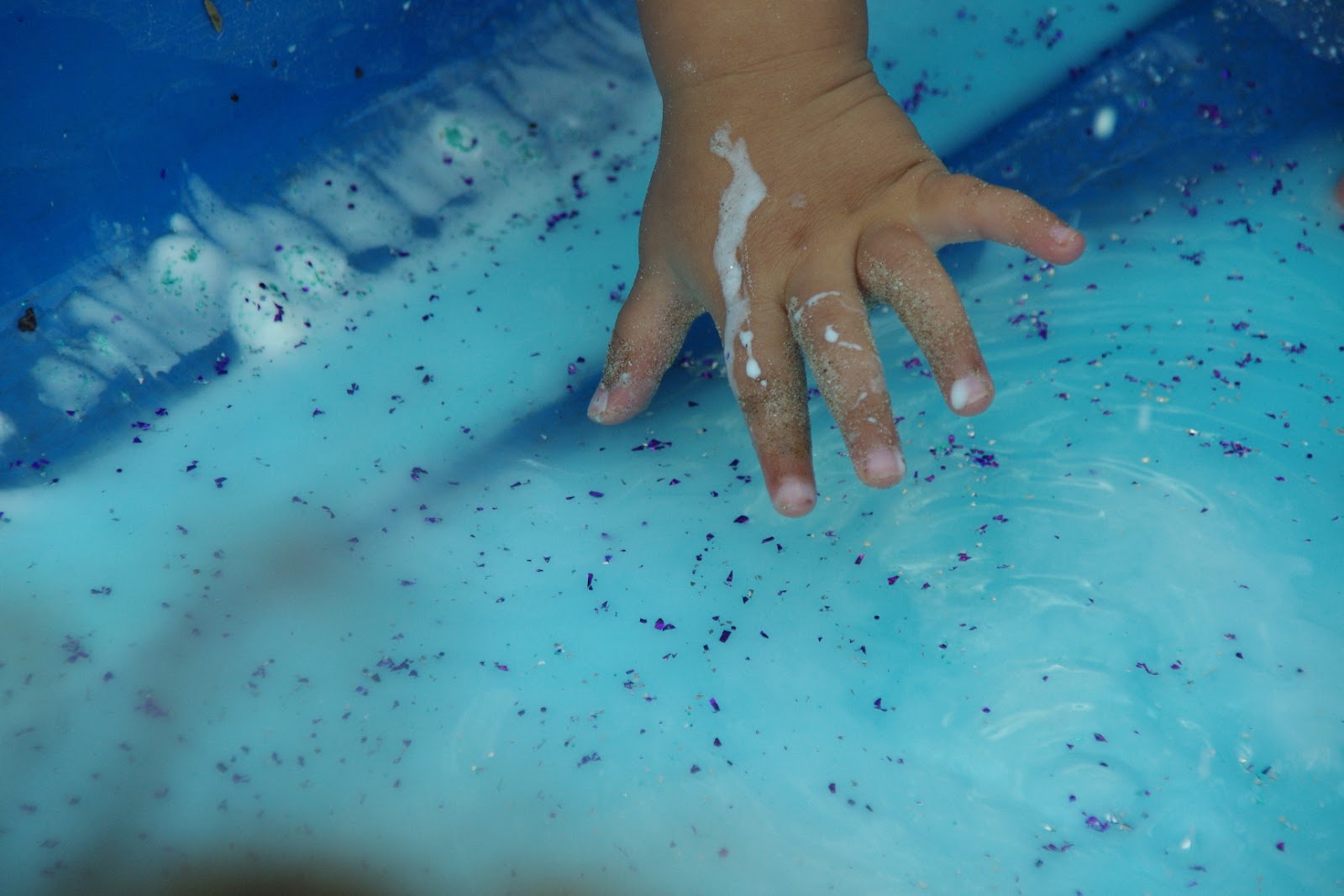
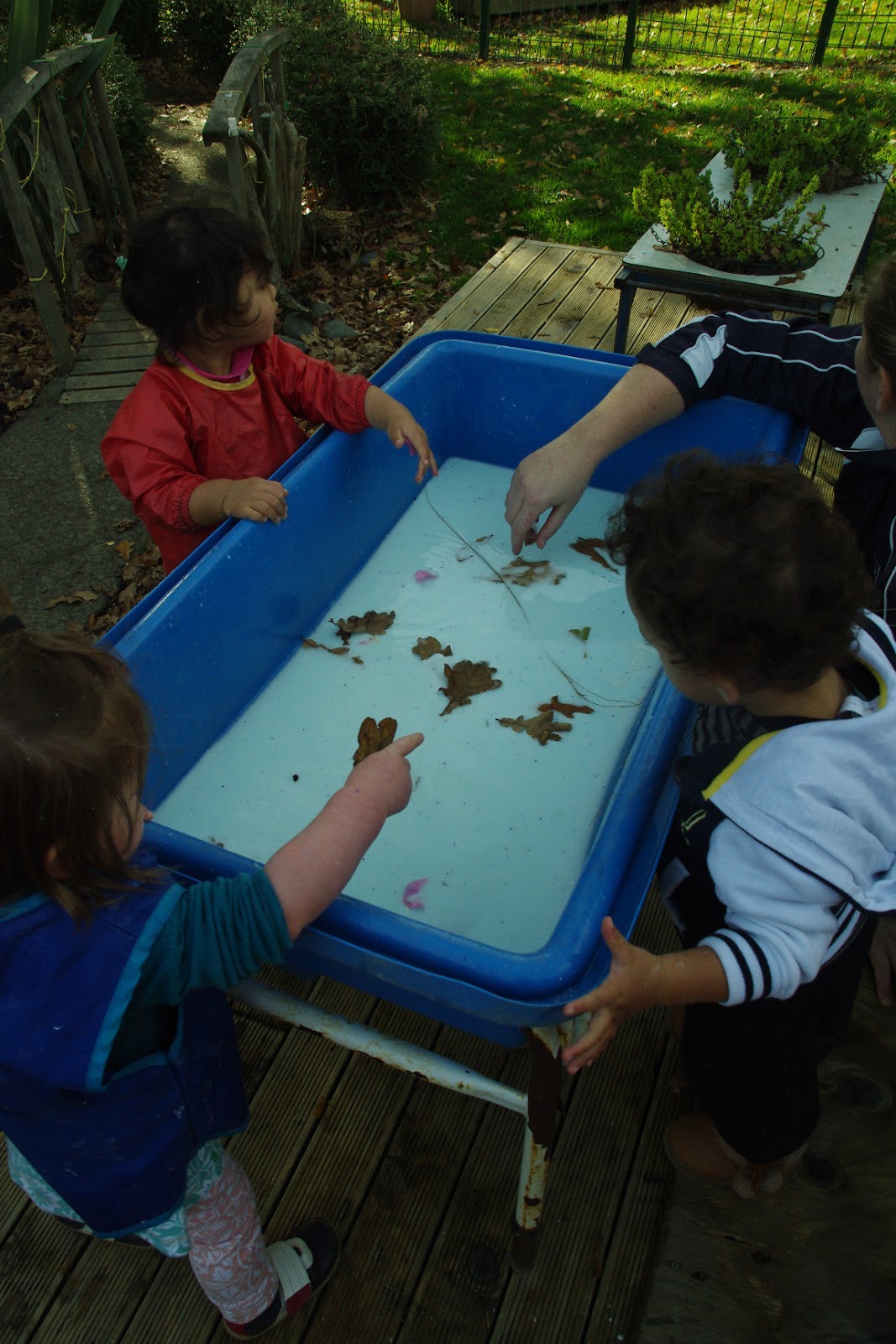
I set up cornflour and water to make slime, added glitter and blue water into a tub outside for the toddlers to have a play in after they had afternoon tea.  The children can learn about water and cornflour making something else, something hard to pick up but will run and fall though the fingers.


The children had lots of fun splashing in the water and pulling the slime off the bottom of the tub or a teacher putting the slime into their hands.  I went with the children's interest one they were out there and after they were splashing in the tub and moving everything around and with more water being added, making the water a milky white, they started adding leaves to play with in the tub.  This empowers the children to facilitate their own learning to learn and grow with the materials around them (Ministry of Education, 1996)


The interacting with the children in this space was fun and enjoyable, they seemed to have lots of fun, laughing and screaming with the items they were playing with, they seemed to enjoy taking over the activity and making it their own by adding things they wanted in there, such as the leaves.  I sat along side them talking to them about what they were doing and playing in the water, milky, leaf water with them, picking up slime and leaves and dropping them.  Some of the children would put their hands under my hand to catch and then drop them again.


"Within minutes, a child can be both dependent and independent, according to changes in temperament, environment, or adult expectations" 
(Ministry of Education, 1996, p. 21).

To ensure the children were safe around the water I had it off the ground so their hands could get into the tub but they couldn't fall into the tub of water, I used hot water before the children came outside so it was warm when they came out and not too hot for their hands.  When adding more warm water I made sure it was out of the hot tap which is a good temp for the children and by the time it got outside it had cooled down a little more making it safe for the children to put their hands into, testing this with my wrist.

What I think worked was the children love water play and they played in it when more warm water was added as they didn't seem to like it cold.  Next time I will add more cornflour as once we added more water the cornflour dissolved, but this also gave the water a neat milky colour.  I liked that the children could make it their own by adding things they wanted in it like leaves. 


Reference:
Ministry of Education. (1996). Te Whāriki: He whāriki matauranga mō ngā mokopuna o Aotearoa: Early childhood curriculum. Wellington, New Zealand: Learning Media.

Wednesday, June 19, 2013

One learning space in the centre


In this area there is normally at least one staff member or student sitting on the edge or in the sandpit with the children, making sure all children are safe.  For the climbing its down in the sandpit with a soft landing if they chose to jump off or lose their footing, staff are there to ensure they are careful but also letting them learn their own safety aspects within reason.  Like letting them jump off the box into the sand, gives the child the power for their own learning, someone is there if the child needs to hold a hand to help them.

There is a shed with all the digging toys, buckets, spades, trucks, sand wheels, and more.  The children have access to this when its open to get out what they would like to use with what has been put out.


Each day there is a different set up and the toddlers can ask for something else to come out or move things around, such as climbing boxes with planks that come off the boxes.  One child decided to move a plank (with help) off a blue step up to the sand so it made a slide.  The children love climbing in the sand pit.


Another day, this was asked by a child if we could put up the wood, the child was confidence to ask for materials to build what he had in mind.  The child knew what he wanted and where he wanted the items to go. (Ministry of Education, 1996)


There is so much learning going on in this play area, including digging and putting sand into buckets, onto walls, on hands and just picking it up to drop. Teachers sit with the children building, digging as this encourages the children to get involved by knocking down castles or adding extra sand to the top of the castles that are made by the teachers, as the children seem to enjoy this getting done "children experience an environment where their play is valued as meaningful learning and the importance of spontaneous play is recognised" (Ministry or education, 1996, p. 84).

Another thing in this area are swings, there are hook at the top for a couple of swings to be attached, children will often point to the hooks asking for the swings and going to the shed where they are stored.  By letting the child decide and the teacher to help them get what they are asking for gives "the confidence and ability to express their ideas and to assist others" (Ministry of Education, 1996).

Reference:
Ministry of Education. (1996). Te Whāriki: He whāriki matauranga mō ngā mokopuna o Aotearoa: Early childhood curriculum. Wellington, New Zealand: Learning Media.

Falling Leaves